What Is a Whirling Dervish? History and Sufi Origins
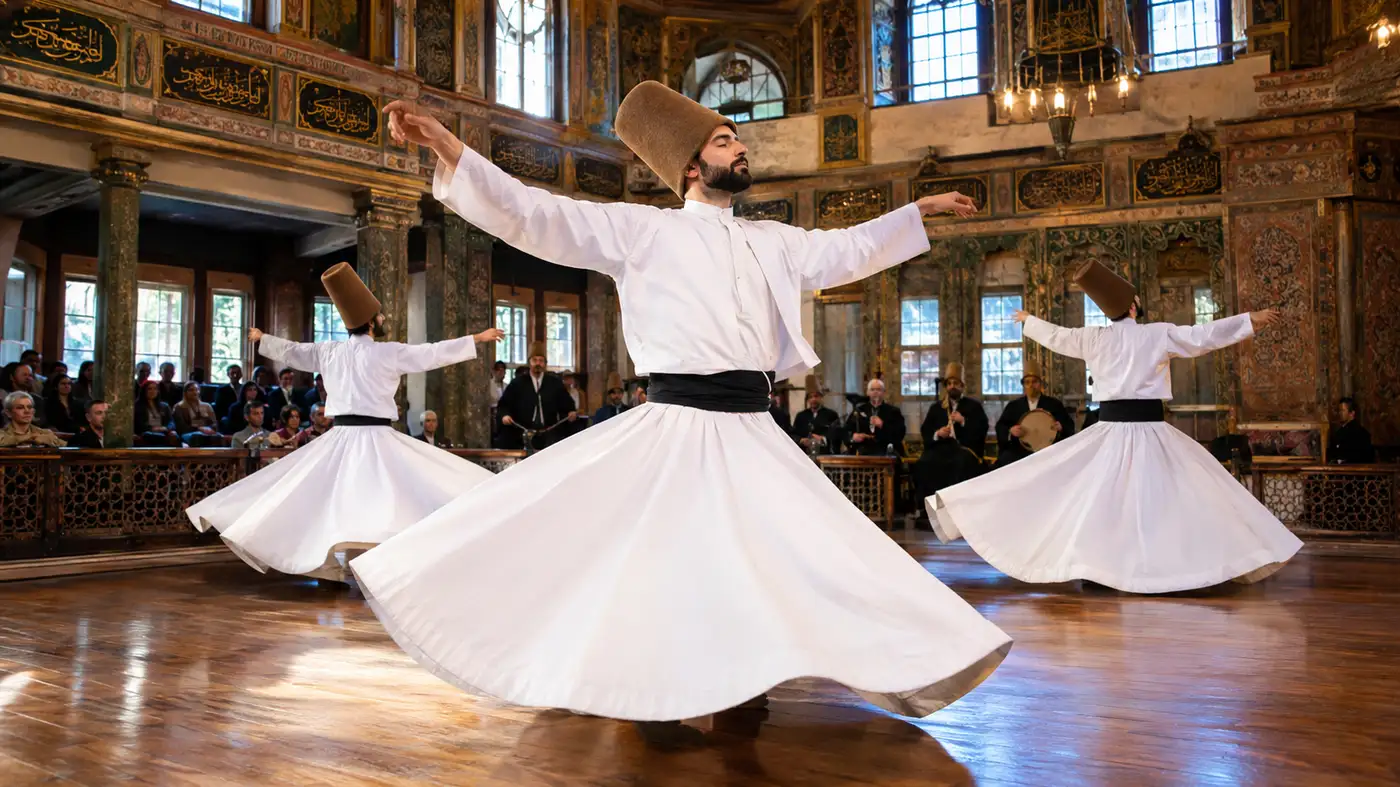
The first time someone asks what is a whirling dervish, they usually picture an exotic stage show in a dim Istanbul cellar with men in tall hats spinning like tops. I thought something similar before I sat in a drafty wooden hall in Konya on an icy December night years ago. Real dervishes are not folk dancers. They are initiates of an ascetic Sufi Muslim path that dates back over seven centuries. To them, the spinning is dhikr, an act of physical remembrance of the divine.
Seeing the ceremony up close changes how you view movement entirely. You notice the quiet friction of bare leather slippers on polished floorboards, the low drone of a reed flute that feels heavy in your chest, and the total calm on the faces of the men turning in circles. Understanding what is the whirling dervish means peeling back layers of 13th-century Persian poetry, Islamic mysticism, and Anatolian cultural survival.
Book your whirling dervish istanbul experience:
The Origin of Whirling Dervish Practice in 13th-Century Konya
The origin of whirling dervish ritual leads directly to one person: Jalal al-Din Muhammad Rumi, the Persian poet and theologian whom locals in Turkey simply call Mevlana, meaning our master. Rumi lived in Konya, a city in the dry heart of central Anatolia, during a turbulent era when the Seljuk Empire was fracturing under Mongol pressure. He was a conventional Islamic jurist with hundreds of students, highly respected and rather formal. That changed completely in 1244 when an itinerant mystic named Shams of Tabriz wandered into town.
Shams dismantled Rumi's intellectual pride. He challenged Rumi to stop reading about divine love and actually experience it. Their intense intellectual companionship shocked Rumi's disciples and family, who felt neglected. When Shams vanished under mysterious circumstances, likely murdered by jealous students, Rumi spiraled into profound grief. He began wandering his garden in Konya, weeping and turning around a wooden pole in spontaneous rhythm. That grief-fueled turning became the seed of the whirling dervish origin story.
Legend has it that Rumi later walked past the shop of a goldsmith named Salah al-Din Zarkub in the Konya bazaar. The rhythmic hammering on gold foil caught his ear. In that clatter, Rumi heard the name of God. He threw his arms wide and began revolving right there on the dusty stone street, swept away by ecstatic love. When Rumi died on December 17, 1273, he called his passing the Shab-e Arus, the Wedding Night, because he was finally uniting with the beloved creator.
Pro tip: If you want to experience the historical core of this tradition, visit Konya during the annual Mevlana festival every December, but book your hotel at least 4 months in advance because rooms sell out across the entire province.
His son, Sultan Walad, possessed the organizational mind his father lacked. Sultan Walad gathered the disciples, codified Rumi's scattered teachings into rules, and established the Mevlevi Order. Under his direction, the raw, spontaneous spinning transformed into a formal, highly structured ceremony known as the Sema. The members became known as Mevlevi dervishes.
Rumi and the Spiritual Path of the Sufi Dervish
To grasp the purpose of the ritual, you have to look at the word dervish itself. It comes from the Persian darvish, which literally translates to "doorway" or "sill," carrying the connotation of a poor person who begs at doors. A sufi dervish is someone who embraces spiritual poverty. In classic Islamic mysticism, ego is the screen that blocks a person from perceiving God. By stripping away social vanity, money, and personal pride, the seeker becomes an empty vessel ready to receive divine light.
A whirling dervish turkey historically was not just anyone who bought a costume and practiced spinning. An aspirant had to spend 1,001 days in a tekke, or monastery, living under strict spiritual supervision. They scrubbed latrines, hauled heavy cords of firewood, prepared meals, and practiced days of silence before they were ever taught a single step of the dance. If a candidate quit on day 999, the training was void, and they walked away empty-handed. Discipline came long before ecstasy.
Sufism sees the entire universe as an act of perpetual rotation. Electrons spin around atoms. Blood courses through chambers in our hearts. Planets track orbits around their stars. When the sufi whirling dervish turns, he does not invent a new movement. He joins the existing cosmic hymn. It is an intentional surrender. For an intimate breakdown of every phase of this liturgical performance, you can read our guide to the meaning and ritual of the Mevlevi Sema ceremony.
The Four Stages of the Sema Ceremony
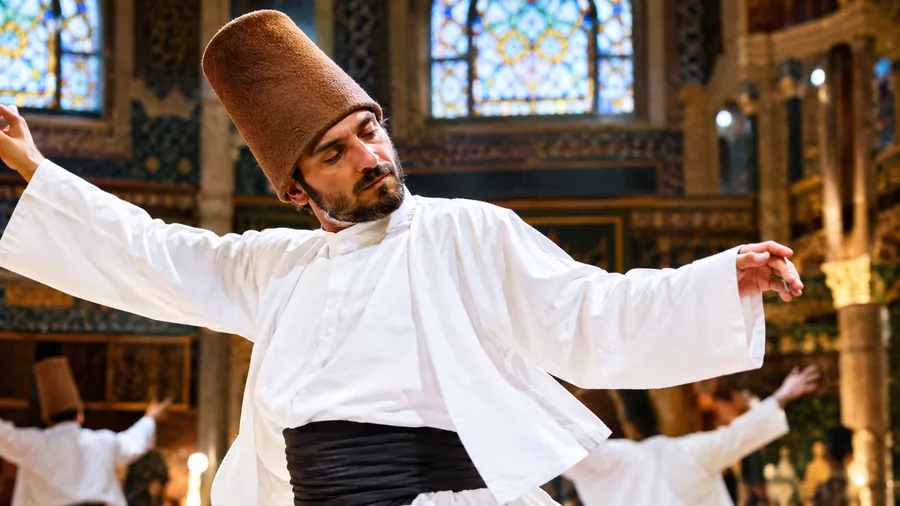
People often call the participants dervish dancers, yet the men do not consider this a dance at all. Dance seeks an audience. The Sema seeks God. The ceremony unfolds in four distinct musical and movement phases called Selams, each reflecting a specific step on the soul's journey toward divine connection and back to worldly duty.
The ceremony opens with a solo eulogy praising the Prophet Muhammad, followed by the deep, resonant beat of a kettledrum representing the divine command of creation: "Be." Then comes the plaintive cry of the ney, the reed flute. Rumi wrote that the ney represents the human soul, cut from its native reed bed, groaning in homesickness for the divine source. Only after this music softens the heart does the physical movement begin.
During the ritual, the participants turn counter-clockwise on the left heel, pushing off with the right foot like a compass anchored to the center. They rotate between 25 and 35 times a minute, sustained for up to 15 minutes at a stretch without breaking rhythm or stumbling. Here is how the four Selams structure that journey:
| Stage | Spiritual Theme | Pace and Music | Dervish Mindset |
|---|---|---|---|
| First Selam | Awareness of Creation | Slow, measured, solemn rhythm | Recognizing human existence and the majesty of God as creator |
| Second Selam | Awe of Divine Order | Moderately faster, layered strings | Feeling wonder at the sheer scale and harmony of the universe |
| Third Selam | Ecstatic Dissolution | Rapid, soaring vocals and tempo | Total surrender of ego; love transforming into complete ecstasy |
| Fourth Selam | Return to Daily Servitude | Calm, quiet, descending melody | Accepting the earthly condition and returning home to serve humanity |
Notice that the ceremony does not end on a frantic, spinning high. The fourth movement brings the dervish right back to the cold earth. Mysticism without service is viewed as useless indulgence in the Mevlevi tradition. You touch the infinite, then you walk back to the kitchen and wash the dishes.
Book your whirling dervish istanbul experience:
The Symbology: Robes, Hats, and the Spinning Dervish Mechanics
Nothing on a spinning dervish is decorative. Every inch of cloth worn in the hall is a walking cemetery of the ego, designed to remind everyone present of their mortality.
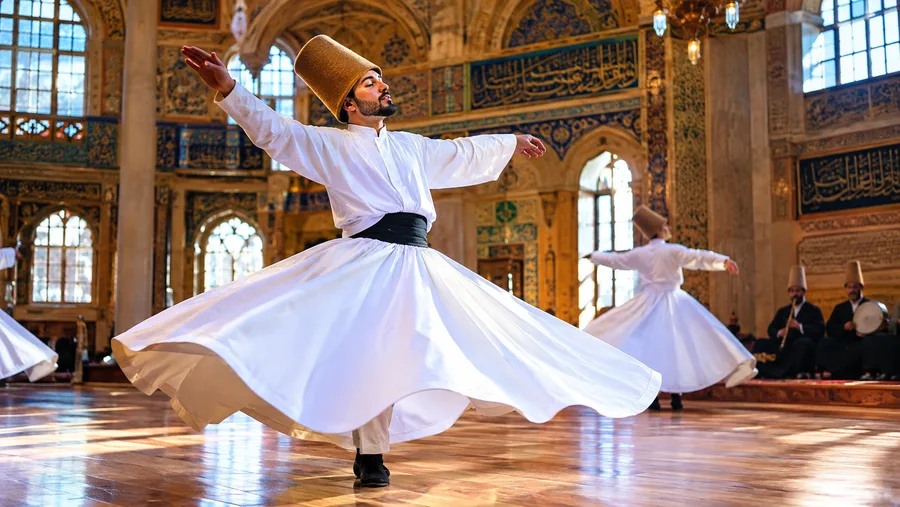
The tall camel-hair hat, called a sikke, represents the tombstone of the ego. The black cloak, the hirka, symbolizes the dark grave itself. Beneath it, the wide white skirt, called a tennure, stands for the burial shroud. When the dervishes enter the hall, they are wrapped in their black cloaks, sitting motionless like corpses waiting for judgment. When they cast off the black cloak, they step out of the grave resurrected in pristine white.
- The Sikke: A rigid, conical hat made of pressed sheep wool that represents the tombstone resting above the human ego.
- The Tennure: A flared white skirt that opens like a lily blossom as the spinner gains momentum, representing the burial shroud.
- The Right Hand: Turned upward toward the ceiling, open with the palm flat, gathering divine grace from heaven.
- The Left Hand: Turned down toward the wooden floor, channeling that received light down to the earth without keeping any for itself.
I remember wondering how the spinning dervishes avoid vomiting after twenty straight minutes of rapid turning. The technique is purely mechanical, passed down quietly for generations. The dervish does not fixate on the room. He tilts his head slightly to the left, keeping his ear near his shoulder, resting his gaze loosely on his left thumb. By keeping the focal point locked to his own rotating body, the inner ear fluid stabilizes, and dizziness disappears.
Note: Flash photography during genuine Sema performances is strictly forbidden because sudden bursts of light can blind the turners and break their concentration, leading to physical collisions on the floor.
From Secret Tekkes to Modern Turkey: Where the Tradition Stands
The Mevlevi Order was a political and cultural powerhouse for centuries throughout the Ottoman Empire. Sultans took vows with Mevlevi sheikhs, and imperial princes learned to play the ney. tekkes dotted Damascus, Cairo, Belgrade, and Istanbul. But the collapse of the empire altered everything. In 1925, Mustafa Kemal Atatürk, the founder of the modern secular Republic of Turkey, banned all Sufi lodges by law. Tekkes were shuttered, ritual clothes were outlawed, and the order was forced underground to protect the nation's new secular identity.
For roughly three decades, the Sema lived on only in private living rooms, whispered in Konya and Istanbul behind drawn curtains. Then, around the early 1950s, the Turkish government realized tourists found the ritual fascinating. They permitted the performance to return as a "cultural presentation" rather than an open religious lodge. Today, UNESCO recognizes the Mevlevi Sema ceremony on the Representative List of the Intangible Cultural Heritage of Humanity.
This creates an ongoing tension. If you walk past the tourist shops in Sultanahmet, you will see flyers advertising dinners where you can eat grilled lamb while watching a spinning dervish on a riser between tables. Most traditional Mevlevis despise those dinner shows. They treat the ceremony as holy prayer, not evening entertainment. If you are planning an itinerary, do yourself a favor and seek out historic lodges or cultural centers by checking our verified list of authentic places to see whirling dervishes in Istanbul instead of booking a novelty restaurant display.
If you attend an authentic Sema in Istanbul, Bursa, or Konya, keep basic etiquette in mind to respect the practitioners:
- Dress modestly: Cover your shoulders and knees out of respect, just as you would inside an active mosque.
- Hold your applause: Do not clap when the spinning stops; silence honors the quiet prayers concluding the ritual.
- Remain seated throughout: Avoid getting up or pacing the perimeter for camera angles while the prayers are being sung.
Frequently Asked Questions about what is a whirling dervish
Why do whirling dervishes spin instead of walking or bowing?
Spinning reflects the natural movement of the physical universe, from atoms to rotating galaxies. The Mevlevis spin counter-clockwise around the heart to draw their awareness away from earthly concerns and concentrate completely on divine love.
Are whirling dervishes only found in Turkey?
While Turkey is the birthplace and spiritual center of the Mevlevi Order, active Sufi lodges and whirling practitioners also exist across Syria, Egypt, Iran, and several communities in Europe and North America.
Can women become whirling dervishes?
Historically, women practiced the Sema in separate women's quarters inside Mevlevi tekkes. In modern times, several mixed groups allow women to whirl alongside men, though more conservative branches still keep the public ceremony all-male.
Quick Reference
- Founded in Konya during the late 1200s
- Rooted in the poetry of Jalal al-Din Rumi
- Costumes represent grave clothes and ego burial
- Recognized by UNESCO as intangible cultural heritage
Book your whirling dervish istanbul experience:
My Take on the Living Tradition
It is easy to get cynical about tourist attractions in Turkey, especially when you see plastic spinning dervish figurines for sale on every street corner. But seeing a real Sema in a historic hall cut through my skepticism completely. The discipline required to turn continuously for fifteen minutes, completely lost in music without a hint of vertigo, is astonishing to watch. If you go, skip the dinner shows, find an actual cultural foundation or historical tekke, silence your phone, and let the drone of that reed flute take you somewhere quiet.
Read more about whirling dervish istanbul.